- How does it feel to give an interview to a Catholic Newspaper?
The question slightly amuses me, but I see why I’m being asked that. I do have a very mixed view of the Catholic Church, because I think what happens to most religions is that after the initial spiritual height of the first generations of ministering the religion, that spirituality slowly diminishes and the churches begin to take on an ordinary human egotistical aspect. For example, when you have Christ’s teaching, which is primarily of poverty, humility and tolerance, 2000 years later you have a Catholic Church that is very rich and very powerful and quite authoritarian. Similarly, I find it hard to believe that Jesus Christ would have regarded burning people alive as a correct interpretation of his Gospel of love. So, there’s usually a very large gap between the teachings of the founder of the religion and the people who centuries later are administering it. This does not mean that there are not some very fine people within the Catholic Church. I have known a couple myself and they work within the church regarding their job as to do their best within a framework that they often cannot truly believe in. So, I have no worries at all about being interviewed by a Catholic newspaper because some of the people reading the interview will understand and probably be reasonably sympathetic to my views.
- How would you describe your own relationship to faith and religion? Has there been development in your life?
I think my lifelong quest, albeit a very dilettante one, has been to try to find meaning. And I think that any such meaning that would satisfy me would have some element of religion about it. However, when I’m asked if I believe in God, I simply have to say I don’t know what it means. I do believe there may be a real purpose in the Universe and I believe that there may be a force out there that people who have a religious experience contact. I think some people who have undergone rigorous spiritual training may contact that beneficial force more often than most of the rest of us are lucky enough to do. And I believe that contact with that benevolent force is very beneficial to the people who make it and even to the people around the people who make it. I don’t think there’s any question that some degree of stillness sometimes brings a spiritual experience which causes people’s behaviour to become more and more unselfish.
- Did you ever think that theologians and religious teachers would one day deal with The Life of Brian in a positive way?
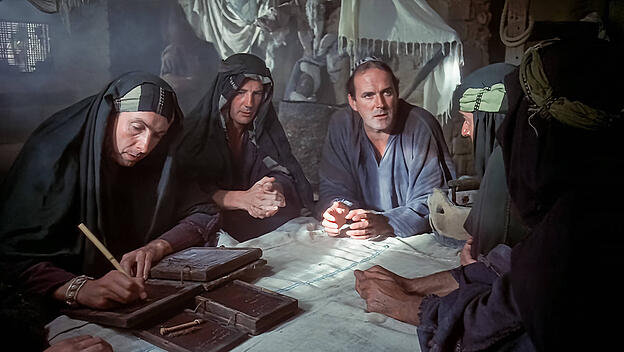
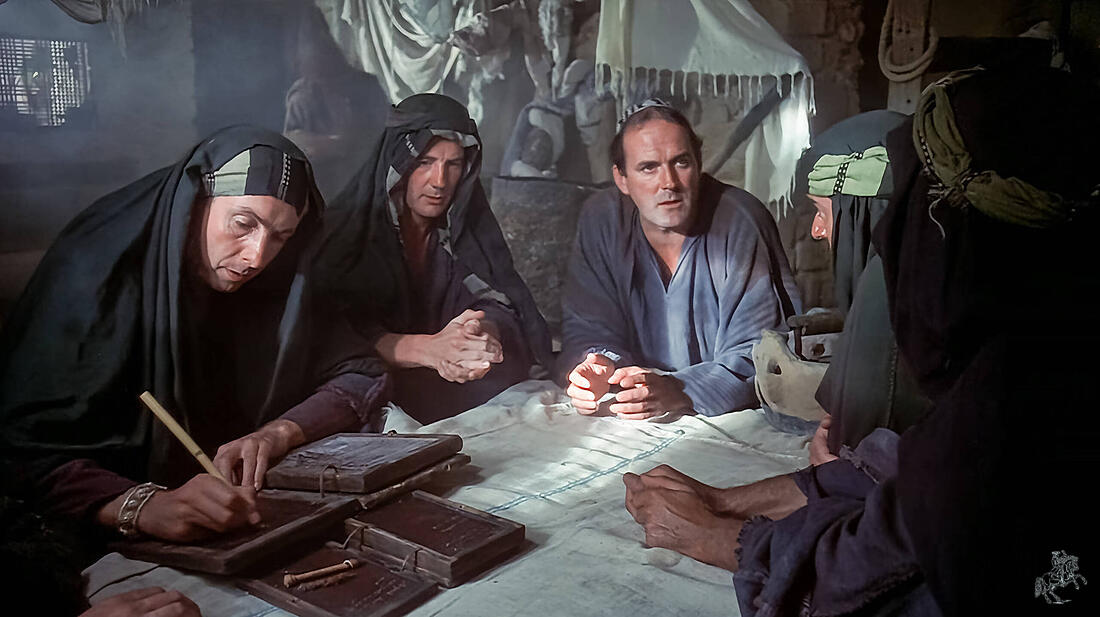
The answer is no, we never thought that anyone would take it seriously, although we are making very serious points in the film. It’s clear at the start that we have Jesus talking about the Beatitudes and that is treated with the utmost respect. But we then pan to the people listening, who are engaged in the most futile of egotistical arguments. Our purpose is to show that because someone claims to be a Christian does not mean that their behaviour is particularly in tune with Christ’s teachings. One only has to see the ridiculous nature of prosperity Christianity in the United States to realise that some people can take a teaching and more or less turn it on its head. So I think that’s the main lesson that Life of Brian is saying is that people can take a religion and more or less do the opposite of what the founder counselled them to do, while maintaining all the social prestige of being able to call themselves in this case Christians.
- Nowadays, opposition to the film comes less from the religious side and more from the politically correct side. What do you think of this development?
I think political correctness starts out as a very warm, generous and good impulse and then deteriorates rather rapidly until it becomes, in its reductio ad absurdum, quite harmful. I think people who try to make other people good by forceful legislation always finish up with something far worse than they had started with. I think that laughter is an extraordinarily positive force. The fact is always that laughter is critical, but I see it as nudging us in the direction of behaving more intelligently. I don’t see it as mean spirited if it is true humour. There are mean spirited jokes and they are extremely nasty and should not be made, but I don’t know that we should be censoring people’s language in the way that we are at present. There have been more academics fired in the last few years under the impact of woke than there were in the entire McCarthyite period. I believe this is wrong. To seek out something that somebody said seven years ago and then to get them fired for that is the opposite of kindness and charitability and also the opposite of every decent and important principle in liberal democracy. I think that laughter is an incredibly powerful force and that when people laugh it puts them in a more positive part of their minds from which they can deal with difficult circumstances better than if there is no laughter to be seen. And for the woke people to try and cut down on the amount of laughter in the world reminds me of the Puritans who deemed a Christmas pudding was sinful and idolatrous. I think that a lot of their ideas are completely wrong and based upon a distorted view of post-modernists who have done enough damage anyway.
Die Printausgabe der Tagespost vervollständigt aktuelle Nachrichten auf die-tagespost.de mit Hintergründen und Analysen.